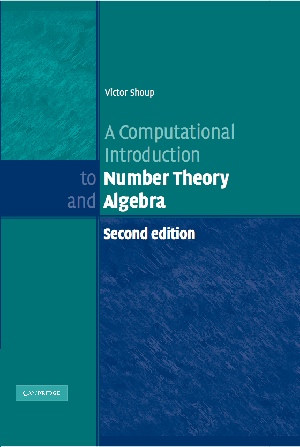
A Computational Introduction to Number Theory and Algebra
Provides an introduction to number theory and algebra, with an emphasis on algorithms and applications.
Tag(s): Mathematics
Publication date: 16 Jun 2008
ISBN-10: n/a
ISBN-13: n/a
Paperback: 533 pages
Views: 42,603
Type: N/A
Publisher: Cambridge University Press
License: Creative Commons Attribution-NonCommercial-ShareAlike 2.0 Generic
Post time: 01 Sep 2006 11:53:28
A Computational Introduction to Number Theory and Algebra
Provides an introduction to number theory and algebra, with an emphasis on algorithms and applications.
Publication date: 16 Jun 2008
ISBN-10: n/a
ISBN-13: n/a
Paperback: 533 pages
Views: 42,603
Document Type: N/A
Publisher: Cambridge University Press
License: Creative Commons Attribution-NonCommercial-ShareAlike 2.0 Generic
Post time: 01 Sep 2006 11:53:28
Share — copy and redistribute the material in any medium or format
Adapt — remix, transform, and build upon the material
The licensor cannot revoke these freedoms as long as you follow the license terms.
Click here to read the full license.
Victor Shoup wrote:All rights reserved. The right to publish or distribute this work in print form belongs exclusively to Cambridge University Press; however, this electronic version is distributed under the terms and conditions of a Creative Commons license (Attribution-NonCommercial-NoDerivs 2.0).
Book Excerpts:
Number theory and algebra play an increasingly significant role in computing and communications, as evidenced by the striking applications of these subjects to such fields as cryptography and coding theory. The goal of this book is to provide an introduction to number theory and algebra, with an emphasis on algorithms and applications, that would be accessible to a broad audience. In particular, this book should be accessible to typical students in computer science or mathematics who have a some amount of general mathematical experience, but without presuming too much specific mathematical knowledge.
Inside this book, all of the mathematics required beyond basic calculus is developed ?from scratch.? Moreover, the book generally alternates between ?theory? and ?applications?: one or two chapters on a particular set of purely mathematical concepts are followed by one or two chapters on algorithms and applications -- the mathematics provides the theoretical underpinnings for the applications, while the applications both motivate and illustrate the mathematics. Of course, this dichotomy between theory and applications is not perfectly maintained: the chapters that focus mainly on applications include the development of some of the mathematics that is specific to a particular application, and very occasionally, some of the chapters that focus mainly on mathematics include a discussion of related algorithmic ideas as well.
The mathematical material covered includes the basics of number theory (including unique factorization, congruences, the distribution of primes, and quadratic reciprocity) and abstract algebra (including groups, rings, fields, and vector spaces). It also includes an introduction to discrete probability theory -- this material is needed to properly treat the topics of probabilistic algorithms and cryptographic applications. The treatment of all these topics is more or less standard, except that the text only deals with commutative structures (i.e., abelian groups and commutative rings with unity) -- this is all that is really needed for the purposes of this text, and the theory of these structures is much simpler and more transparent than that of more general, non-commutative structures.
Prerequisites:
The mathematical prerequisites are minimal: no particular mathematical concepts beyond what is taught in a typical undergraduate calculus sequence are assumed.
The computer science prerequisites are also quite minimal: it is assumed that the reader is proficient in programming, and has had some exposure to the analysis of algorithms, essentially at the level of an undergraduate course on algorithms and data structures.
Tweet
About The Author(s)

Victor Shoup is a Professor in Computer Science Department, Courant Institute of Mathematical Sciences, New York University. His research interests include the design, analysis, and implementation of algorithms for solving problems in the area of number theory and algebra; and the design and analysis of cryptographic protocols.
Victor Shoup is a Professor in Computer Science Department, Courant Institute of Mathematical Sciences, New York University. His research interests include the design, analysis, and implementation of algorithms for solving problems in the area of number theory and algebra; and the design and analysis of cryptographic protocols.