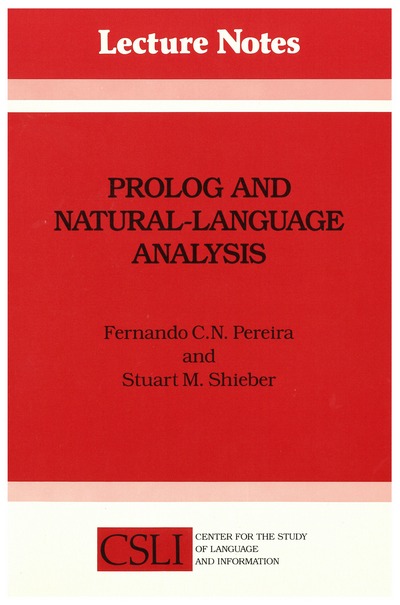
Prolog and Natural-Language Analysis - Digital Edition
An introduction to elementary computational linguistics from logic programming point of view using Prolog.
Tag(s): Artificial Intelligence
Publication date: 01 Jul 1987
ISBN-10: 0971999704
ISBN-13: n/a
Paperback: 273 pages
Views: 26,128
Type: Lecture Notes
Publisher: Cambridge University Press
License: n/a
Post time: 25 Oct 2005 09:40:21
Prolog and Natural-Language Analysis - Digital Edition
An introduction to elementary computational linguistics from logic programming point of view using Prolog.
Publication date: 01 Jul 1987
ISBN-10: 0971999704
ISBN-13: n/a
Paperback: 273 pages
Views: 26,128
Document Type: Lecture Notes
Publisher: Cambridge University Press
License: n/a
Post time: 25 Oct 2005 09:40:21
Terms and Conditions:
Fernando C. N. Pereira wrote:This digital edition of Pereira and Shieber's Prolog and Natural-Language Analysis is distributed at no charge by Microtome Publishing under a license described in the front matter and at the website. A hardbound edition (ISBN 0-9719997-0-4), printed on acid free paper with library binding and including all appendices and two indices (and without these inline interruptions), is available from www.mtome.com and other booksellers.
Book excerpts:
This book is an introduction to elementary computational linguistics from the point of view of logic programming. The connection between computational linguistics and logic programming has both formal and utilitarian aspects. On the formal side, this book explores the restricted logical language of definite clauses as a means of expressing linguistic analyses and representations. On the utilitarian side, this book introduces the logic-programming language Prolog, whose backbone is the definite-clause formalism, as a tool for implementing the basic components of natural-language-processing systems.
The main goal of the book is to enable the reader to acquire, as quickly as possible,a working understanding of basic computational linguistic and logic programming concepts. To achieve this goal, the book is organized around specific concepts and programming techniques, with examples supported by working programs. Most of the problems involve programming and also supplement the material in the main text. Although we have emphasized experimental rather than analytic or comparative questions, all concepts and techniques covered are given rigorous, if informal, theoretical justification.
Given the orientation of the book, it limited the discussion of issues of a more general nature, such as comparisons with other computational linguistic techniques or formal mathematical results. Three areas stand out among the omissions. First, this book does not compare the logic programming approach with other approaches to natural language processing, in particular the closely related unification-based grammar formalisms. Second, this book does not present or compare the plethora of grammar formalisms based on logic programming. Finally, this book does not address formal-language-theoretic issues of generative power and computational complexity for the formalisms and analysis mechanisms this book present.
Intended Audience:
This book presupposes some acquaintance with elementary notions from logic, formal language theory, computer science and linguistics.
Reviews:
Amazon.com
:) "This book provides, in one volume, one of the best introductions to prolog programming and one of the best introductions to natural language processing. It is virtually unique in that it shows how to interface a natural language interface to a theorem prover."
Tweet
About The Author(s)

Fernando Pereira is Distinguished Scientist at Google, where he leads projects in natural-language understanding and machine learning. His previous positions include chair of the Computer and Information Science department of the University of Pennsylvania, head of Machine Learning and Information Retrieval Research at AT&T Labs, and several roles at SRI International.
Fernando Pereira is Distinguished Scientist at Google, where he leads projects in natural-language understanding and machine learning. His previous positions include chair of the Computer and Information Science department of the University of Pennsylvania, head of Machine Learning and Information Retrieval Research at AT&T Labs, and several roles at SRI International.

Stuart Shieber is James O. Welch, Jr. and Virginia B. Welch Professor of Computer Science in the School of Engineering and Applied Sciences in the Faculty of Arts and Sciences at Harvard University. His primary research field is computational linguistics, the study of human languages from the perspective of computer science.
Stuart Shieber is James O. Welch, Jr. and Virginia B. Welch Professor of Computer Science in the School of Engineering and Applied Sciences in the Faculty of Arts and Sciences at Harvard University. His primary research field is computational linguistics, the study of human languages from the perspective of computer science.