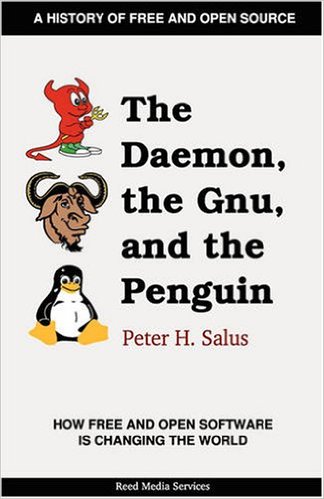
The Daemon, the GNU and the Penguin
Shows the reader just what went into the creation of open source and its worldwide network of contributors and users over the past 50 years.
Tag(s): Software Libre and Open Source
Publication date: 01 Apr 2007
ISBN-10: 097903423X
ISBN-13: 9780979034237
Paperback: 204 pages
Views: 17,988
Type: Book
Publisher: n/a
License: Creative Commons Attribution-NonCommercial-NoDerivs 2.0 Generic
Post time: 08 Oct 2007 08:59:41
The Daemon, the GNU and the Penguin
Shows the reader just what went into the creation of open source and its worldwide network of contributors and users over the past 50 years.
Publication date: 01 Apr 2007
ISBN-10: 097903423X
ISBN-13: 9780979034237
Paperback: 204 pages
Views: 17,988
Document Type: Book
Publisher: n/a
License: Creative Commons Attribution-NonCommercial-NoDerivs 2.0 Generic
Post time: 08 Oct 2007 08:59:41
Share — copy and redistribute the material in any medium or format
The licensor cannot revoke these freedoms as long as you follow the license terms.
Click here to read the full license.
The revolution of knowledge has led us to exploration and discovery. The computer, the Internet, and the Web have led to a similar revolution. While certainly no computer user, Thomas Jefferson, in a letter to Isaac McPherson (13 August 1813), wrote:
If nature has made any one thing less susceptible than all others of exclusive property, it is the action of the thinking power called an idea, which an individual may exclusively possess as long as he keeps it to himself; but the moment it is divulged, it forces itself into the possession of every one, and the receiver cannot dispossess himself of it.
My aim is to show how the advent of the computer and the Internet have given rise to the expansion of the academic/scholarly notions of sharing, and how this in turn has brought us free and open software, which will bring about a major change in the way we do business.
This effort is more than a history of Linux, of the Free Software Foundation (FSF), the Internet, software licensing, and myriad other topics. It will contain a number of histories within it, which (I hope) will serve as an antidote to the cloud of FUD stirred up by those who fear that change will mean that their businesses will fail (certainly more a sign of lack of imagination and flexibility than of anything else).
On the contrary: change yields opportunity. But change also requires adaptability. We are embarking on a new business model, which will change the way we do business as much as mass production and global electronic communication did over the 19th and 20th centuries.
Since 1990, there has been an insistent drumbeat of anti-FSF FUD. Since 2000, this has focused on Linux. Some examples of this are:
* On June 1, 2001, Steve Ballmer, CEO of Microsoft, told the Chicago Sun-Times: "Linux is cancer."
* On October 15, 2002, Darl McBride, CEO of The SCO Group, said: "We are more committed to Linux than ever before."
* On March 4, 2003, Blake Stowell, SCO director of Public Relations, said: "C++ is one of the properties SCO owns."
* On May 14, 2004, the Alexis de Tocqueville Institution issued a press release in which it revealed that its Director, Ken Brown, had discovered that Linus Torvalds had not "invented" Linux.
* On August 26, 2004, Kieran O'Shaughnessy, director of SCO Australia and New Zealand, told LinuxWorld: "Linux doesn't exist. Everyone knows Linux is an unlicensed version of Unix."
The remarks are noise. But though ludicrous, statements like these make businessfolk fearful. They then hug Windows the way a different Linus clutches his blanket. My goal here is to show a wider audience just what went into the creation of open source and its worldwide network of contributors and users over the past 50 years.
Over four centuries have passed since our static heliocentric universe was replaced by a dynamic one. Today, the business model that has persisted since the late eighteenth century is being replaced. Here's how it's happening.
Tweet
About The Author(s)
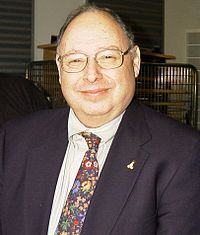
Peter H. Salus is a linguist, computer scientist, historian of technology, author in many fields, and an editor of books and journals. He has conducted research in germanistics, language acquisition, and computer languages. He has a 1963 PhD in Linguistics from New York University. He is best known for his books on the history of computing, particularly A Quarter Century of UNIX and Casting The Net (a history of the Internet up to 1995).
Peter H. Salus is a linguist, computer scientist, historian of technology, author in many fields, and an editor of books and journals. He has conducted research in germanistics, language acquisition, and computer languages. He has a 1963 PhD in Linguistics from New York University. He is best known for his books on the history of computing, particularly A Quarter Century of UNIX and Casting The Net (a history of the Internet up to 1995).